
What was the factory on Factory Road?
Behind the station, a linen works with 500 looms had an unusual place for its workers to eat.
1863–1964
Erskine Beveridge’s linen works stood there. The workers ate in the former Free Church, which later became a blacksmith’s shop.
Read the 1930 newspaper accountThe linen workers on Factory Road used to eat their dinner in a church. It stood behind Cowdenbeath station, beside Erskine Beveridge’s factory. The Free Church congregation opened it in 1863 and moved to a new building in 1891. The linen works took over the old church and used it as a dining hall and storehouse.
Two weavers in Cowdenbeath
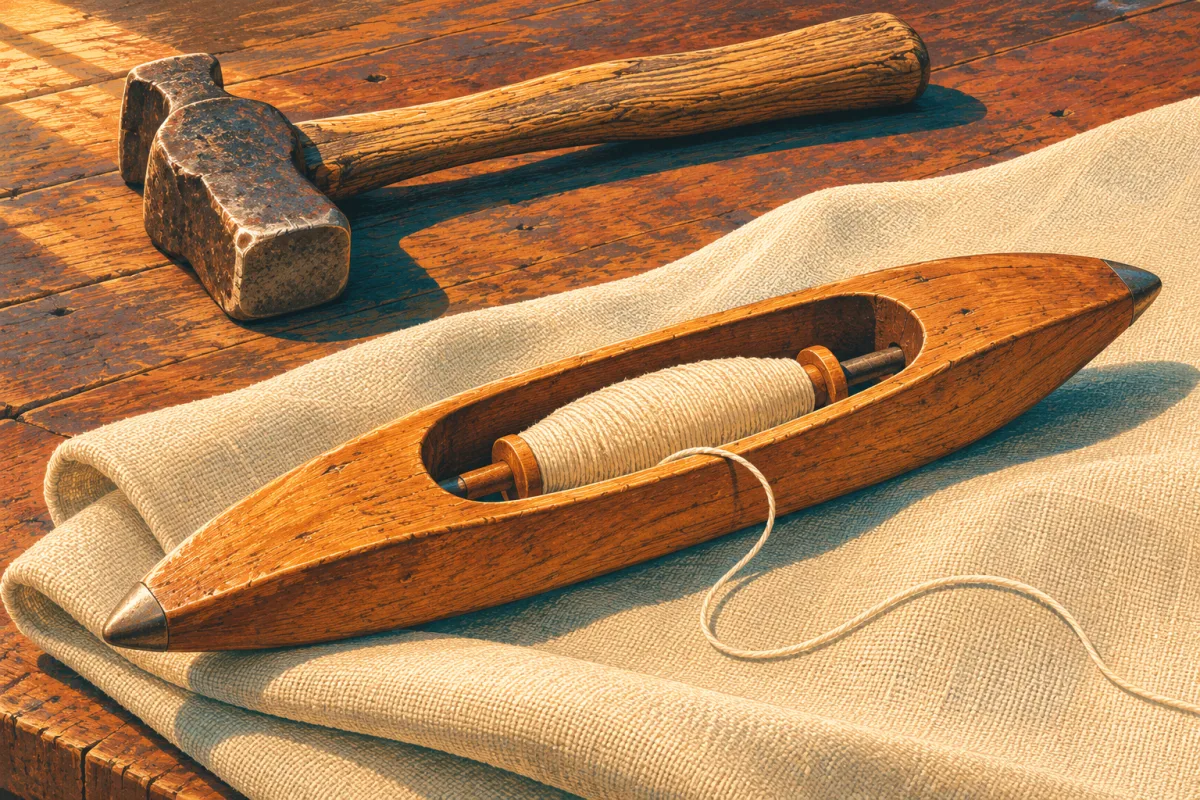
Before the First World War, Beveridge’s Cowdenbeath factory had 500 looms. A damask weaver made the pattern at the loom. Even in plain white linen, the petals of a woven flower could catch the light differently from the cloth around them. OnFife holds a sample book from Beveridge’s Dunfermline business.
Isabella Whyte, 19, of 43 Broad Street, and Margaret Muir, 17, of 3 Foulford Place, both gave their occupation as damask factory weaver when they married in the spring of 1901. Their marriage entries leave the employer unnamed. Some weavers travelled a fair way from home. The Dunfermline Journal Almanac for 1905 described special trains that carried women from Cowdenbeath and Lochgelly to the Dunfermline factories for a six o’clock start.
A smithy behind the station
By June 1930 a blacksmith had set up his anvil in the old church. The West Fife Echo reported the change and recalled the factory workers who had eaten there. The mill closed between the wars. By 1964 council houses stood on its old site behind the High Street, between the railway embankments.
Factory and parish records
- National Records of Scotland, Cowdenbeath Free Church records and West Fife Echo, 25 June 1930, “Church as a Blacksmith’s Shop”.
- Scottish Industrial History, volume 16, p. 33, on the looms and workers’ trains, and OnFife’s linen collection and Beveridge sample book.
- Cowdenbeath War Memorial’s transcriptions of the marriage entries for Isabella Whyte and Margaret Muir.
- Peter J. Smith’s 1964 study of the Fife coalfield, p. 62, on housing at the former mill.